
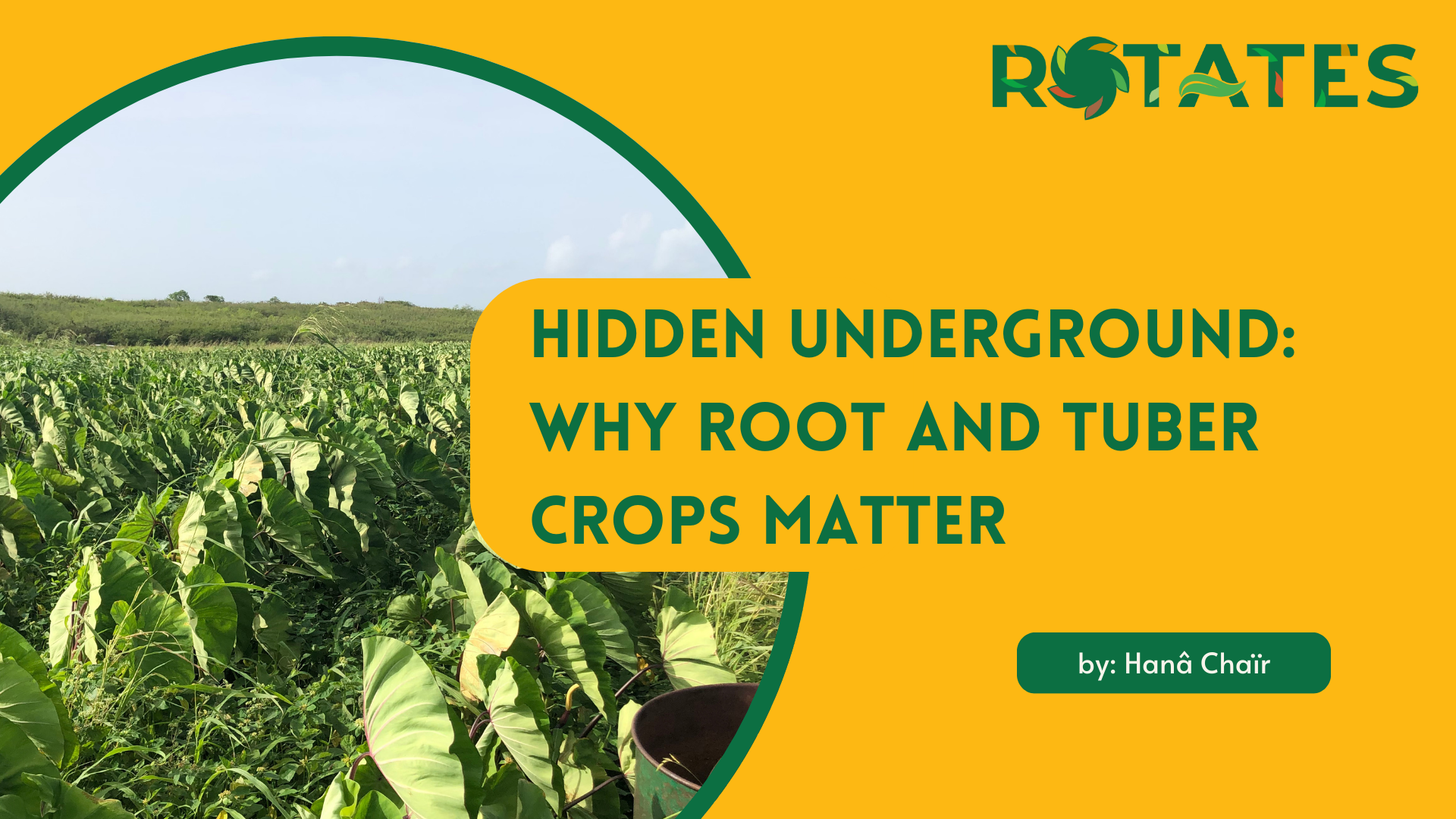
Author: Hanâ Chaïr, PhD, ROTATES project Coordinator, CIRAD
Minor root and tuber (MRT) crops, namely sweet potato, yam, cassava, and taro, are among humanity’s oldest food allies. Cultivated for their starchy underground organs and prized for their carbohydrate-rich energy, these crops have sustained communities for millennia, particularly across tropical regions. Long before agriculture took root, archaeological evidence shows that hunter-gathers were already harvesting some of these species in the wild, relying on them as dependable sources of nourishment.
Although domesticated independently in different parts of the world, these crops share strikingly similar traits and social prestige in their regions of origin. In many cultures, they are far more than food and are deeply embedded in local traditions. They are used in traditional ceremonies, serve as marriage dowries, and are featured in funeral ceremonies. Beyond their cultural significance, root and tuber crops remain vital pillars of agricultural systems worldwide, underpinning food security for millions.

From Tropical Fields to European Shores
The global journey of root and tuber crops is inseparable from the story of early navigation and the Columbian Exchange. While the most widely known crops are those introduced from the Americas, with potatoes and tomatoes championed, lesser-known travellers, such as the sweet potato, also crossed oceans. At the same time, crops originating in different parts of the Old World also spread along the maritime routes used by European navigators. Yams and taro, for example, reached the Macaronesian Islands, Spain, and Portugal, where ships often stopped to resupply or set sail. Some introductions, however, predated these routes; taro, for instance, is believed to have reached Europe as early as the first millennium.
The island of Cyprus offers a particularly illustrative example of this longer history of crop movement and adaptation. Introduced during the Roman Empire, taro – known locally as “kolokasi” – was likely brought from Egypt and Syria along established trade routes. By the late twelfth century, kolokasi had clearly secured its place in Cypriot agriculture and cuisine. Its presence is documented as early as 1191 AD, when it was reportedly served at the wedding of Richard the Lionheart and Berengaria of Navarre at the Castle of Limassol. From imperial trade routes to medieval banquets, this enduring presence highlights how root and tuber crops, though often considered as minor in Europe, were successfully adapted by local communities and incorporated into regional food traditions.
Over time, this long history of adaptation began to give way to new agricultural priorities. As access to major staples such as potatoes and wheat improved, root and tuber crops gradually faded from mainstream European agriculture. They became known locally as “ancestral crops” or “grandparents’ crops.” Despite all this, today, certain varieties are still cultivated in small regions of Spain, Portugal, France, Italy, and Greece. Classified as underutilised or orphan crops, they remain understudied and underfunded in Europe.
Healthy Foods, Clean Crops
Minor Root and Tuber (MRT) crops pack a powerful nutritional punch. Naturally gluten-free and rich in starch, many varieties also boast a low glycaemic index (GI) and high levels of health-promoting compounds mainly anthocyanins and carotenoids. They can be enjoyed in countless forms – fried, mashed, boiled – or transformed into innovative ingredients for modern diets.
Their versatility extends far beyond the kitchen. MRT crops have a high potential for processing in no to low gluten free or/and lactose free products, and they work well as a partial substitute for cereals in many preparations including bread, pasta and pastries. They are also promising ingredients for plant-based alternatives such as yogurts and ice-creams, aligning perfectly with today’s food trends.
From a livestock perspective, MRT crops are equally valuable as a source of energy. Carbohydrates make up 80-90% of their dry weight, allowing them to largely replace cereals in feed destined for livestock when supplemented with a nitrogen source. Even their by-product matter: MRT foliage has variable but generally high protein content, making it an excellent, high-quality feed option that combines energy and nutrition.

Farming with Nature, Not Against It
One of the most compelling advantages of MRT crops lies in how they are grown. They typically require little to no pesticides or herbicides and show more resilience to climate change. Well suited to intercropping or crop rotation, they are likely to have positive impacts on ecosystem service provision.
Their reduced reliance on pesticides supports biodiversity, offering habitats for many species, including natural pest predators. Protein and nitrogen-rich foliage can be repurposed as animal feed or for soil amendment. Even their water needs are well aligned with natural cycles: MRT crops demand more water in spring during their leaf production, when availability is higher, unlike cereals whose peak demand comes during drier summer months for their grain filling, when water availability is reduced.
Crops for the Future
As climate change accelerates, MRT crops are emerging as strategic assets in strengthening the resilience and sustainability of European agriculture. By broadening the range of cultivated species, they can diversify production systems, increase farmers’ incomes, and offer nutritious alternatives to cereal-based diets. Rising temperatures are already shifting the geographic limits of conventional crops, and even optimistic climate scenarios suggest this trend will continue. In this evolving context, many tropical crops, especially short-cycle MRT varieties, are becoming increasingly suitable for temperate climates, making them strategically important for future agricultural systems.
At the same time, European consumers are seeking more diverse, nutritious, and sustainably produced foods. Interest in MRT crops is growing among both consumers and food processors, yet, FAOSTAT data shows that Europe still relies heavily on imports to meet this growing demand. Beyond their value as food, MRT crops also generate by-products which contribute to reduce the gap between feed supply and demand. Local production of MRT-based feed can substantially lower costs and decrease reliance on imported feedstuffs, therefore cutting the environmental impact associated with long-distance transport.
Digging Deeper into Opportunity
The resurgence of MRT crops represents more than a dietary trend. It’s a major opportunity to rethink EU agriculture. By diversifying production systems, these crops can boost farmers’ incomes, promote agroecological practices, and reduce the dominance of monoculture systems. At the same time, they offer consumer health, sustainable alternatives that reconnect modern diets with agricultural heritage.
Responding to this opportunity, the ROTATES project is working to unlock the full potential of minor root and tuber crops in Europe. By bringing together research, innovation, and value-chain actors, ROTATES aims to overcome current barriers to cultivation, processing, and market uptake. The project focuses on developing sustainable production systems, improving processing and valorisation pathways, and supporting the integration of MRT crops into European food and feed systems—thereby reducing reliance on imports and strengthening regional resilience.
In this context, what grows beneath the soil may hold the key to a more resilient, sustainable, and nutritious future for Europe’s agri-food systems, one in which minor root and tuber crops, supported by initiatives like ROTATES, play an increasingly important role.
