
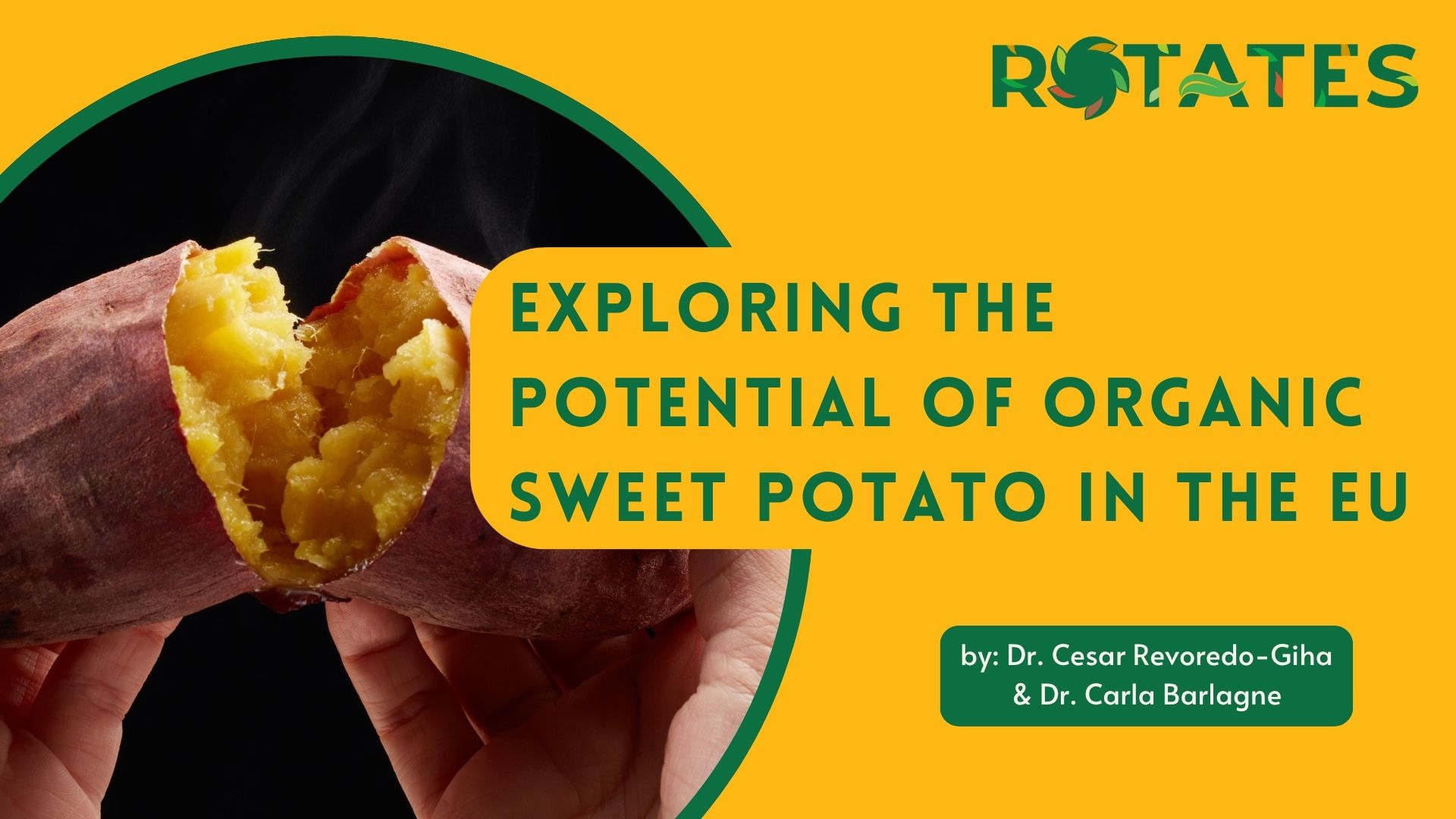
Authors: Dr. Cesar Revoredo-Giha, Professor of Food Supply Chain Economics, Food Marketing Research Team Leader (SRUC) and Dr. Carla Barlagne, Agricultural economics researcher (INRAE)
The promotion of agrobiodiversity is more frequently seen as a way to fight against the challenges faced by modern agriculture with benefits such as improved landscape conditions and better nutritional outcomes. The ROTATES project aims to sustainably enhance agrobiodiversity and ecosystem services by introducing and promoting starchy root and tuber crops, currently underutilised in Europe. This note looks at the current situation of sweet potatoes (Ipomoea batatas) in countries where the project is active.
Sweet potato in France
Although the supply of sweet potatoes in France still relies heavily on imports, local production is increasing to meet the rising consumer demand. Annual tonnage varies, but production in 2024 was estimated at 24,000 tonnes. During the local production season, which lasts from September to January, French sweet potatoes account for only about 40% of the total market supply. [1]
The cultivation is concentrated in the south of the country, especially in Occitanie, Nouvelle-Aquitaine and Provence-Alpes-Côte d’Azur (PACA) with smaller cultivation in the western regions such as Pays de la Loire, Bretagne and Normandie. Growth has been supported by the adoption of orange-skinned varieties like Beauregard, Orléans and Jewell. Among them, Beauregard stands out for its disease resistance, strong yields and adaptability to different soils and climates.
At the same time, the domestic sector faces numerous constraints, including the absence of coordination among the relevant actors, inadequate technical support, insufficient infrastructure for storage and processing, sensitivity to local pests, harsh winters that require short-cycle varieties, tuber curing and pre-rooted seed plants. Competition from imported products also remains strong.
On the consumer side, sweet potatoes are becoming increasingly popular thanks to their nutritional qualities and culinary versatility. They also offer an easy way to diversify everyday diets, something reflected in the growing number of recipes and food products available. Over the last decade, demand has increased due to interest in healthy foods, plant-based diets, changing eating habits and greater exposure to international cuisines. This trend has also encouraged the growth of the French processing sector.
Sweet potato in Greece
Greece has a Mediterranean climate characterised by hot, dry summers and mild, rainy winters, which makes growing tropical root vegetables like sweet potatoes a challenge. Nevertheless, some areas of Greece can support sweet potato cultivation on a small scale during the hot summer months.
The latest information from the FAO estimates that Greece harvested about 8.3 thousand tonnes of sweet potatoes in 2020. Figure 1 shows that although yields have shown an increasing trend since the late 1990s, the area planted has remained stable although with high variability. As a result, total production has also remained uneven.

Sweet potato cultivation is particularly concentrated in the regions of Ilia, Achaia, and Messenia, which account for roughly 68% of national production. On the Greek mainland, sweet potatoes are usually planted in May and harvested in late September or October before the winter cold arrives. Irrigation is essential to provide sufficient moisture. As in France, the most common sweet potato variety is the orange-fleshed Beauregard.
The crop is appreciated for being relatively low maintenance, although it requires significant water during the summer. Key challenges include high production costs, possible crop losses due to pests in wet years, and the need for consistent, high-quality yields. At the same time, the sector is becoming more professionalised, with growing attention to organic production and export opportunities.
Farmers in Greece are capitalising on the rising demand in both local, and in international markets (e.g., Germany, Spain, and Cyprus). Nevertheless, sweet potato production in Greece is still very low, although farmers find that sweet potatoes can yield substantial profits despite their high production costs.
Consumers in Greece enjoy sweet potatoes in many forms: baked, mashed, fried into fritters or chips, added to casseroles, blended into soups, or used in desserts. While they are not yet a mainstream ingredient in Greek cooking, domestic interest has clearly increased.
Sweet potato in Portugal
The supply of sweet potato in Portugal is made mostly of domestic production, and the crop is an important part of the agricultural sector. Figure 1 shows the area, production and yields.

The main growing areas are in the South-eastern Coastal Area, particularly Aljezur (Algarve) and the Alentejo region. Harvesting and production generally extend from September to April/June, although most harvests take place in October and November. The major varieties in Portugal include Beauregard (orange-fleshed), Rubina, and the locally renowned Lira (yellow pulp/red skin). The Aljezur region is particularly famous for its sweet potato as the climatic conditions proved to be ideal for its cultivation, something that earned the variety a Protected Geographical Indication.
Despite all this, Portuguese producers face challenges with storage, packaging, and increasing production costs, often storing products to wait for better prices.
Sweet potatoes in Portugal are consumed both fresh and processed. A traditional preparation is simply boiled, with or without seasoning, often as an alternative to potatoes or other starches. A large share of production is also processed after cutting and freezing, including for products such as baby food.
Final remarks
Sweet potatoes are already well known in the countries examined, both among producers and consumers. Demand is rising strongly in France, while in Portugal and Greece domestic demand appears more stable. At the same time, producers in Portugal and Greece are benefiting from increasing export opportunities.
High production costs remain a common issue across all three countries. This matters because sweet potato competes with alternative crops that may offer higher returns or require fewer resources, such as water.. Another shared challenge is competition from low-cost imports.
Within ROTATES, the focus is on organic sweet potatoes. However, evidence on consumer interest in organic sweet potatoes is still limited and may depend on factors such as price, perceived nutritional benefits and environmental awareness. This is one of the questions the project will continue to explore in the coming years.
[1] We are most grateful to Professor Laurent Legendre for providing information about the sweet potato sector in France
